LGBTQ+ Fertility: A Guide to Fertility for Transgender Parents

There are many paths to achieving pregnancy for the LGBTQ+ community. Often, which path you take depends on factors like cost, time, personal preferences, biology, and more. For transgender people looking to welcome a child into their family through a biological connection with one or more of the parents, there are a few additional considerations to keep in mind. These may include navigating hormone therapy while trying to conceive, fertility preservation prior to medical transitions, timeline considerations, and working with donor sperm. Explore this resource to learn more.
This resource is part of a webinar series sponsored by California Cryobank. Guest speakers included Eddie Cervantes (California Cryobank) and Liam Kali, Licensed Midwife, Director of MAIA Midwifery and Fertility, and author of Queer Conception: The Complete Guide for Queer and Trans Parents to Be.

Common paths to pregnancy: At-home insemination and assisted reproduction
Apart from intercourse, queer and trans folks often use at-home insemination or assisted reproduction to become pregnant. Below are a few of the more common paths to pregnancy. The right avenue for you and your family will depend on financial, emotional, and biological resources and needs.
Learn more about these processes and their associated costs.
IVI is when the donor sperm is deposited into the vaginal canal without specifically targeting the cervix. ICI is when the donor sperm is deposited in the cervical canal (an outdated practice).
IUI occurs when donor sperm is inserted via a tube directly into an individual’s uterus to facilitate fertilization.
IVF is a procedure that involves removing eggs from an individual’s ovaries and fertilizing them outside of the body with sperm in a laboratory. The resulting embryos are then transferred into a uterus through the cervix.
R-IVF is a series of medical procedures in which eggs are harvested from one person’s ovaries, fertilized in a laboratory, and transferred to another person’s uterus.
Fertility considerations for people assigned female at birth
If you’re someone who produces eggs, you might choose to pursue pregnancy yourself. You may also choose to maintain a biological connection to your child by harvesting your eggs for IVF with a surrogate or R-IVF with a partner.
Trying to conceive
Contrary to popular belief, it is still safe and possible to get pregnant even if you’ve been taking testosterone (T). In fact, licensed midwife Liam Kali notes that it’s even possible to get pregnant while on T. However, they recommend stopping before trying to conceive.
For those who lost their cycle or have irregular periods while on T, Kali says that it will take up to six months for your menstrual cycle to return to normal. At that point, your likelihood of pregnancy is about the same as a cis woman at your age. You would then remain off of T for the length of your pregnancy. You can start T again within a few weeks after birth.
Egg harvesting and R-IVF
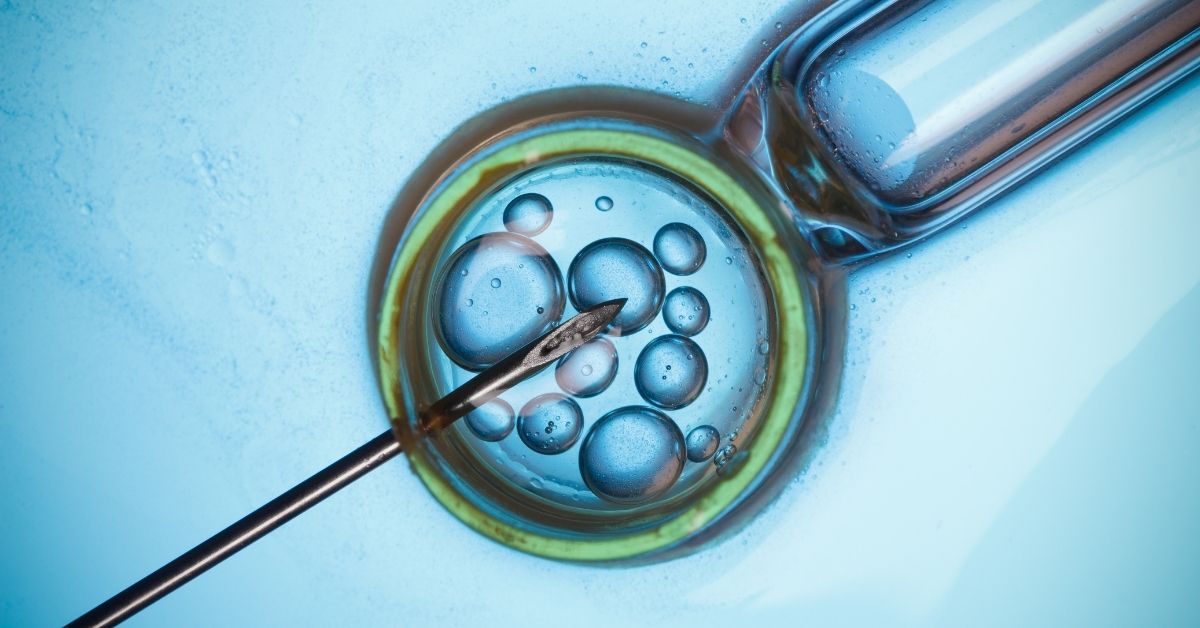
There are also trans people who might want to provide eggs for R-IVF in the event that their partner or someone they know is able and willing to be pregnant and give birth. While there’s not a lot of research in this area, Kali says it’s typical to go off T for about a month. Then, you would jump right into egg stimulation and retrieval. They add that you can go back on T immediately afterwards. This means that you’d only need to be off T for a couple of months. In fact, since T doesn’t impact the quality of eggs — only the quantity — there are some doctors who will harvest eggs without discontinuing testosterone.
Fertility preservation
In addition to harvesting your eggs for R-IVF, many trans people choose to freeze their eggs. This is especially true if they’re planning a hysterectomy, oophorectomy, or other procedures related to medically transitioning. The process for this mimics the one above. You’d have to go off of T for only a few months: the one month it takes to “wash” it out of your system, and then the time necessary for egg stimulation and retrieval.
Lactation
Once you’ve welcomed a baby into your family, you might decide to chest feed. Kali notes that a lot of people chest feed successfully on T. In fact, there are a number of cis women with elevated testosterone who lactate and feed their babies without issues. Learn more about lactation by watching our conversation with expert Jacob Engelsman.
Working with a sperm donor
People who produce eggs — especially if they’re in relationships with other people who produce eggs — often also need to consider working with a sperm donor to achieve pregnancy. Consider whether you want to work with a known donor or an unknown donor. This will help you understand if you want to access donor sperm through a cryobank or other avenue.
At a popular cryobank like California Cryobank, unknown donors will undergo a series of robust background checks, medical examinations, and other processes to ensure that the donors are both physically and mentally prepared for donation. Learn more about working with sperm donors.
Note: There are many different kinds of cryobanks, and you may be motivated to work with one because of a lower price. While all cryobanks are required to follow the guidelines of the Food and Drug Administration (FDA), not all of them will have the same precautions in place to ensure high-quality sperm.
Fertility considerations for people assigned male at birth
Estrogen and reproductive function
For people who can produce sperm and were born without a uterus, your main option for maintaining a biological connection to your child is likely to provide the sperm and find someone else to carry the pregnancy. This is because, according to Kali, uterus transplants are still very rare and have only been done with a handful of ciswomen.
For trans women, research shows that hormone therapy does lower fertility markers. For this reason, many transfeminine people are advised to freeze their gametes before starting hormones. However, Kali recognizes that not everybody has access to the resources necessary to freeze and store gametes. Others still might decide not to do that when they start taking hormones but could change their mind later.
The good news is that there are studies that show that a portion of trans women can make normal sperm cells even after being on long-term hormone treatment! More research is coming out showing that it’s possible to regain your reproductive function after coming off of hormones. In the documented cases we have of trans women conceiving with an egg-producing partner, it’s taken anywhere from eight to 17 months.

Inducing lactation
Inducing lactation is another option for trans women eager to connect to their babies. In our conversation with lactation expert Jacob Engelsman, he notes that inducing lactation might involve taking herbs or medication or pumping up to 8 times a day in advance of your baby’s birth. It’s a serious time commitment, so it’s best to do your research before diving in headfirst!
Consider your timeline
For queer people, when and how to expand your family through pregnancy are questions that go hand-in-hand. Particularly for those who produce eggs, age decreases your likelihood of getting pregnant no matter what path you choose. So, it’s important to think not only about when you want to pursue pregnancy but also whether you want multiple kids and how spaced out you’d like their ages to be.
As Kali notes, if you have your first child at 35, you might have your second child at 38 and your third at 41. All the while, your fertility markers are dropping.
For this reason, many consider freezing their eggs to avoid this steep drop-off. But for trans people — who also may be organizing different aspects of their transition including hormone therapy, surgical intervention, and more — you’ll want to ask yourself:
- Do I want to freeze my eggs or sperm before I start my medical transition?
- Do I have the financial ability to store my eggs or sperm while I wait for the right time to pursue parenthood?
- If not, at what point in my life will I feel ready or comfortable going off hormones in order to pursue parenthood through pregnancy? Do I want to go off T/estrogen this year? In two years? Every single time I want to have a child or all at once?


Funding your fertility journey
One of the biggest considerations to starting a family with insemination or assisted reproduction is navigating finances. As you begin this journey, look into your employer’s medical benefits. Eddie from California Cryobank notes that their agency partners with fertility benefit companies like Progyny, Carrot, and Maven to provide support to parents-to-be. He also said that there are financing partners who provide loan options for various vials and fertility processes including PatientFi, Capex MD, and Future Family.
Trans people have been having babies for as long as everybody else: Forever! But the medical and legal world has been slow to keep up. So, the data regarding how a person’s medical transition influences the fertility journey is often underfunded and constantly evolving.
But there are many communities of support at places like MAIA Midwifery. There are also experts like Kali who have produced resources, host webinars, and are available to provide you with the information you need to make informed decisions for you and your family.

Looking for support on your path to parenthood?
Family Equality hosts virtual peer support groups for transgender parents as well as LGBTQ+ people who are trying to conceive.