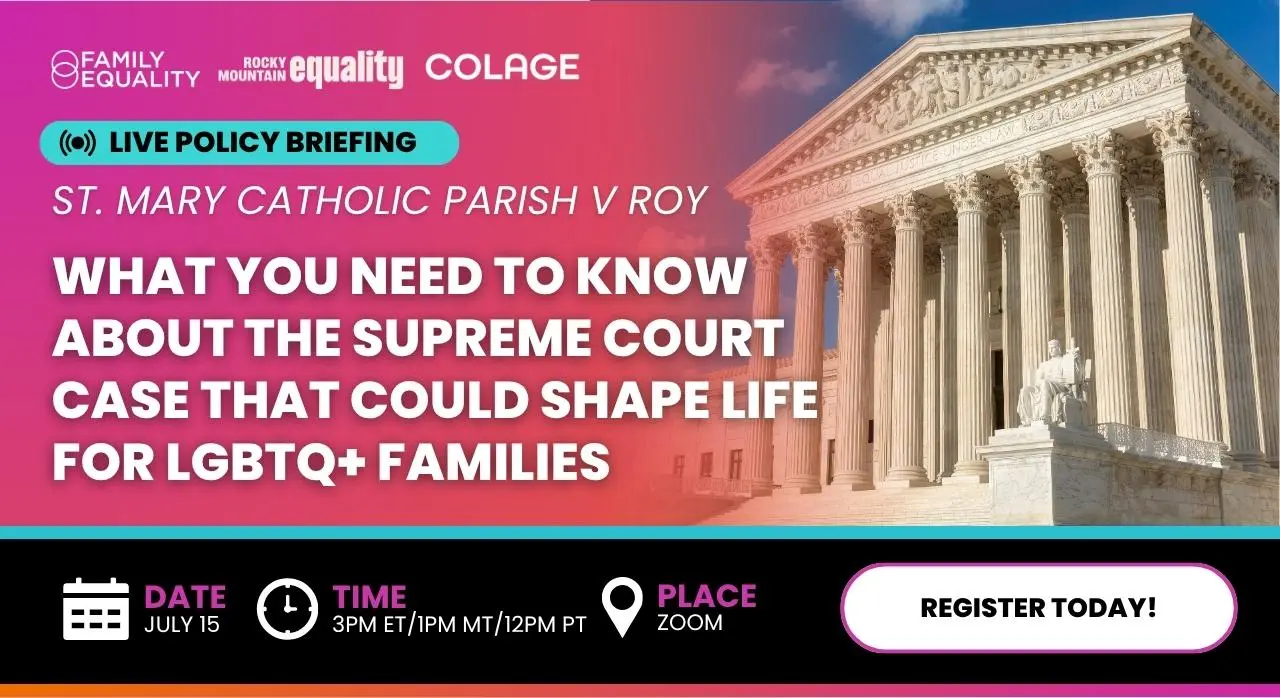
St. Mary Catholic Parish v. Roy

Updated September 9, 2026
No child should be denied access to a publicly funded program just because of who they are or what their family looks like. But a Catholic preschool in Colorado is asking the Supreme Court to allow it to refuse to comply with the state’s antidiscrimination protections while taking taxpayer money as part of Colorado’s Universal Preschool program — sometimes referred to as Universal pre-K or UPK. In effect, this would allow the state-funded schools to deny admission to children with same-sex parents.
Case summary
In 2020, Coloradans voted to approve a universal preschool program to ensure that all children in the state have an equal opportunity to enroll in early childhood education. The program, which provides public funding for universal preschool to public and private preschools, including religious preschools, was officially rolled out in 2022 and requires schools that choose to participate to sign a nondiscrimination agreement that mandates equal enrollment opportunities to all families.
St. Mary Catholic Parish wants to receive taxpayer funds to participate in this program while refusing to comply with the state’s antidiscrimination protections by denying admission to children with same-sex parents. So far, every court that has heard this case, including the Tenth Circuit Court of Appeals, has rejected St. Mary’s argument because Colorado’s conditions for participating in the program are neutral and generally applied to every preschool.
St. Mary and its co-petitioners are now asking the Supreme Court to reverse the Tenth Circuit’s decision.
Oral arguments in this case are set for Tuesday, November 3.

What’s at stake
This case asks whether a church-run preschool can refuse to comply with antidiscrimination laws that protect equal access for LGBTQ+ families while receiving public funding under a Colorado universal preschool program. There are several potential outcomes for this case.
- The Court could rule in favor of Colorado. They could agree that neutral, generally applicable nondiscrimination laws should apply to state-directed benefits funded by taxpayers, including all preschools that opt into Colorado’s universal preschool program. This would be a win for not only LGBTQ+ families but all families that benefit from nondiscrimination requirements.
- The Court could rule that Colorado must exempt St. Mary from part of its nondiscrimination requirement while still allowing it to participate in the state’s universal preschool program. This outcome would deny Colorado’s LGBTQ+ families an equal opportunity to participate in a public benefit. In other words, the Court would sanction state-funded discrimination.
If the Court rules in favor of St. Mary, it could either be a narrow ruling (i.e., based on the very specific terms of the Colorado law in this case) or a broad ruling with far-reaching implications for a state’s ability to enforce any condition on public funding against any religious recipient of taxpayer money.
Colorado developed its universal preschool program to ensure that all families have equal opportunity to enroll in a quality preschool education — a resource that has had a demonstrable impact on a child’s healthy development. But in many communities, especially rural ones, there may be only one or two providers participating in this program.
A ruling in Colorado’s favor means that like all Colorado families, LGBTQ+ families in these communities can enroll in local participating preschools.
However, if the Court decides that some schools can participate in the program while turning away kids because of who their parents are, that would mean that non-LGBTQ+ families relying on universal preschool funding to access preschool would have an opportunity to enroll with local participating providers, while children in LGBTQ+ families could be singled out for exclusion from some of those same providers.
In the most extreme circumstances, this could prevent kids with LGBTQ+ parents in these communities from accessing a publicly funded preschool altogether.
This case is about equal opportunity to enroll in a variety of high-quality, taxpayer-funded preschool options regardless of a family’s composition.
This case is about whether public funds can be used to exclude families.
This case is not about what a church preschool teaches, or about creating inclusive, welcoming, or affirming classrooms.
This case is not about religious freedom.
What we’re doing
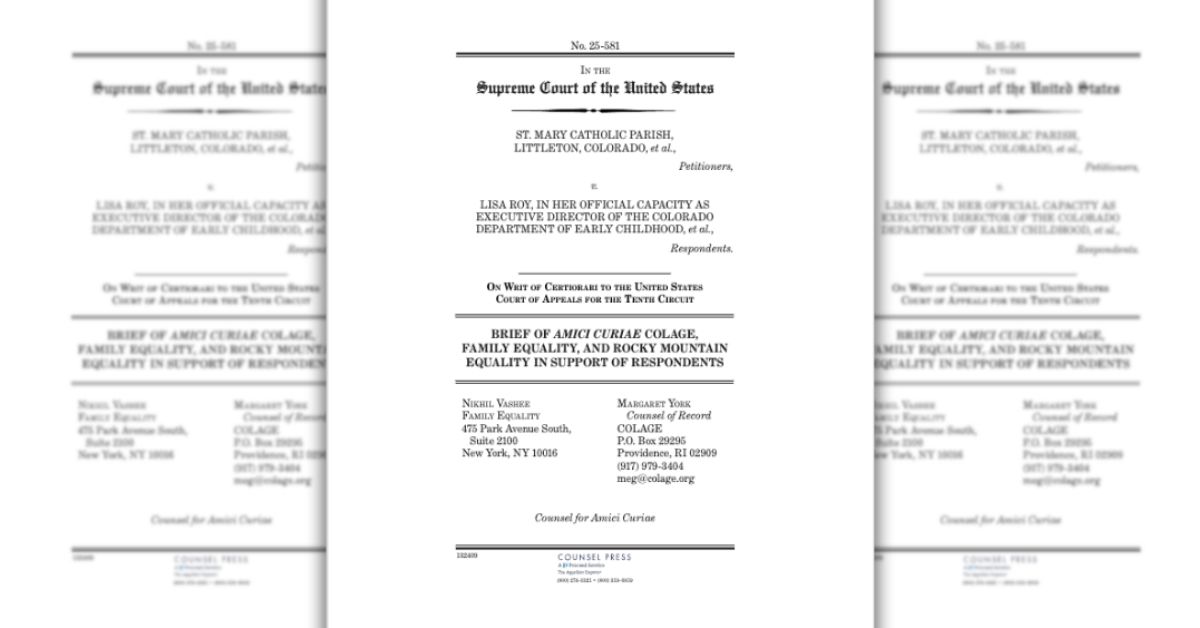
Too often, the perspectives of the real families affected by these cases are missing from debates like this one. That’s why Family Equality, COLAGE, and Rocky Mountain Equality submitted an amicus curiae (friend of the court) brief in this case to share the stories of adult children with LGBTQ+ parents, LGBTQ+ adults, and Catholic parishioners with the Supreme Court Justices so that they can understand what’s really at stake in this case.
Our brief used the stories of our families to show the Court…
- High-quality early childhood education has demonstrated long-term benefits for children and families.
- Many LGBTQ+ families, like all families, are interested in faith-based education.
- What matters most is families having the choice to pursue publicly funded educational opportunities equally.
- Denying LGBTQ+ families access to a universal public benefit is discrimination.


We’re not alone!
Many other experts in the field have submitted similar briefs, including briefs from GLAD Law and Lambda Legal, leading First Amendment scholars, the NAACP Legal Defense Fund, the Disability Rights Education and Defense Fund, the National Women’s Law Center, and more.
Additional resources
This resource has been prepared by: